Page text (OCR, may contain mistakes)
CHASSIS AND BODY MAINTENANCE

Wheel Nut

Whee! inspection

CAUTION:

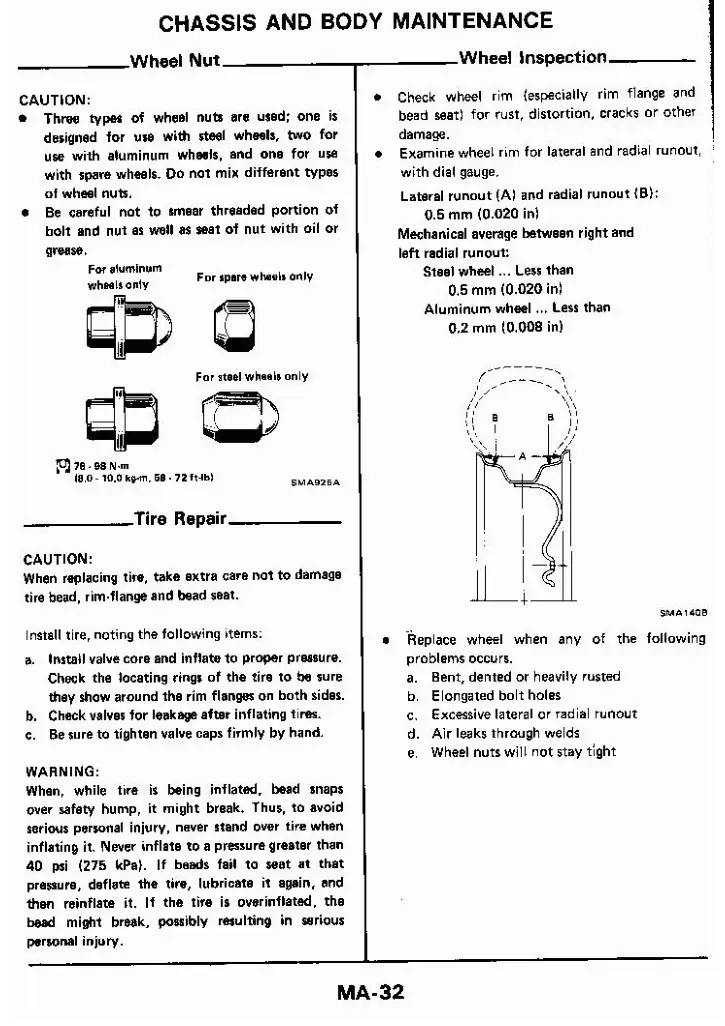
® Three types of wheel nuts are used; one is
designed for use with steal whaels, two for
use with aluminum wheels, and one for use
with sparé wheels. Do not mix different typas
of wheel nuts.

¢ Be careful not to smear threaded portion of
belt and nut as well as seat of nut with ail or
grease.

For aluminum

wheals onty For spare wheels only

For steel whaale only

"78-98 N-m

(8.0 - 10,0 kgm, GB: 72 ft4ib) araAEETE:

Tire Repair

CAUTION:
When replacing tire, take extra care not to damage
tire bead, rim-flange and bead seat.

Install tire, nating the following items:

a. Install valve core and inflate to proper pressure.
Check tha jocating sings of the tire to be sure
thay show around tha rim flanges on both sides.

b. Gheck valves for leakage after inflating tires.

ec. Be sure to tighten valve caps firmly by hand.

WARNING:

Whan, while tira is being inflated, bead snaps
over safaty hump, it might break, Thus, to avoid
serious personal injury, never stand over tire when
inflating it, Never inflate to a pressure greater than
40 psi (275 kPa}. If baads fail to seat at that
prassura, deflate the tire, lubricata it again, and
then reinflate it. If the tire is overinflated, the
bead might break, possibly resulting in serious
personal injury.

Check wheel rim {especially rim flange and
bead seat) for rust, distortion, cracks or other
damage.

Examine wheel rim for lateral and radial runout, °
with dial gauge. |

Lateral runout (A) and radial runout {B}:
0.5 mm (0.020 in}
Mechanical average between right and
laft radial runout:
Staal wheel ... Less than
0.5 mm (0.026 in}
Aluminum wheel ,.. Less than
0.2 mm (0.008 in)

a eee

=
4

Sh4a1d08

Replace wheel when any of the following
problems occurs.

a. Bent, dented or heavily rusted

Elongated bolt holes

Excessive lateral or radial runout

Air leaks through welds

Wheel nuts will not stay tight

aaa gg

MA-32