Browse › Builds & Media ›Racing and dyno

Dyno run last week...

Started by Arro · Apr 3, 2005 · 54postsSMF 2010–26vBulletin 2004–05

Arrodate not saved · #1

I love new products. When I think they work well. When I don't, I pan them. Who am I? I'm not an engineer. I'm not a track mechanic with 30 years of experience. I'm just me, armed with lots of reading, common sense, and my own experiences. It ust so happens that quite often those things combined produce good results for other people.

But sometimes those things show me an issue. And as I am "just me", I speak my piece. Well, I did so with this new strut tower brace (and rear brace).

I've done so to Bart, too, and others before, so I don't have personal reasons. I don't know any of you personally. So what would be the point? But I raise good points I think.

THE PRIMARY PURPOSE OF THIS THREAD IS NOT TO BASH ANYONE, INSULT ANYONE, OR CAUSE ANY CONCERN FOR PERSONAL ATTACK. IT IS SOLELY THE VIEW OF ME, AN INDIVIDUAL, AND DOES NOT REPRESENT THE CLUB OPINION. THERE IS ALSO NO HOSTILITY INTENDED. JUST HONEST OPNIONS.

Now, with that said...

Strut tower bars are designed in a variety of ways. Some are indeed tube design, while others are not. But all have to adhere to certain physical laws. The biggest task they have is to overcome FLEX. When you use a straight brace, that's not an issue. But when your brace has to overcome obstructions, it has to take on a shape that bends around said obstruction.

Depending on the material, weld technique, beam stock design, and bend locations/degrees, it will or will not be successful.

I have no better frame of reference than two bars presently offered for our cars. One uses a tube setup that is welded to circular brackets, and bent to accommodate. The other uses a V-bend and spine design, bolted to heavyiron brackets. I will compare these and show why one of them is, in my opinion, superior. I would caution sensitive would-be vendors to take this as constructive criticism.

Some discussion has ensued on this, and I've modified my original content a bit to reflect it.

Let me clear the air on Bart's brace. There is nothing flat about the design, if we were to flip it over you would see the inner support spine welded in, and the "flat" top is actually convex. This insures it will NOT bend.

Also, the hinging at the ends is standard for many types, because the area of concern is the flexing of any curvature of the centerbeam. The lower suspension, if properly maintained, will keep the hinges at the end from being an issue.

A whole lot of engineering went into this bar, and there were numerous prototypes that got scrapped. The result is a bar that is the absolute STRONGEST brace you can possibly get for the S12 chassis, that is unless some crazy fool takes the same dimentions and CNC machines one out of billet aluminum, bracketed ends and all.

And then there is indeed the issue of clearance. A good brace will accommodate a good number of possible intake/IC pipe setups.

Silli has my favorite IC pipe setup, and serves as a great example. I will include two brace examples below the pic of Silli's engine bay. It should give a good frame of reference.

Silli:
http://memimage.cardomain.net/member_images/1/web/385000-385999/385636_35_full.jpg

Montgomery:
http://www.one-equals-two.net/MMR/Pictures/strutbar.jpg

Bart's:
http://memimage.cardomain.net/member_images/3/web/243000-243999/243105_241_full.jpg

The one that looks like a tank clears better. And I don't like parts resting on each other with an engine known to twist a bit in its bay. The tube-design part has this factor and it concerns me. I would rather have more clearance.

Now, for some of you, looks are important. You want something clean. I can understand that. But with a part designed to improve performance, I would imagine that the sound tuner would consider looks a secondary consideration.

There are epensive braces out there, for sure, and many of them have a nice, shiny look. The brace Bart sells does not. So Bart doesn't charge $$$. He only charges $85. Bear in mind that we aren't driving in BMW's, FD's, Supra Mark 4, or Mercedes. A brace like this isn't bling-bling. It comes unfinished, with no chrome, no paint, no polish, no powdercoating. You want bling you can add it yourself. I myself would probably chrome it and slap a "Club-S12.org" sticker on it, but that's me. But bling aside, something with this much design work gets the job done, and well.

More importantly, most of the common examples of braces out there utilize a CROSSMEMBER attached to the firewall, which gives the initial tower beam MUCH more support. Unfortunately, the tubular design pictured aboe does not. If a crossmember was added to the firewall, I would have disregarded the rest of my concerns. But sans firewall crossmember, it won't be all that flex-resistant.

Something I have noticed about strut braces: The ones without firewall braces seem to usally have TWO tube stocks. Perhaps the pictured tube design could benefit from such a design.

I showed the Mazdatrix one to my Rotary buddy. his first comment was "it's straight." Believe it or not, that makes a difference. Bends introduce flex potential.

And the Hamann brace that was mentioned earlier is hinged at the ends, I might add, not to mention looks like it uses signifigantly beefy pipestock. It also has tight bends which will reduce flex compared to gentle ones. Gentle bends present more flex. The curveature allows for more flex whereas a tight bend will not, as it has less bent area.

Now, regarding rear braces, I spoke with Bart this afternoon and he brings up a very good point I hadn't considered. Do to the design of our rear crossmember, the rear suspension is held very steady, and a rear brace is actually moot. He is right of course, and my FSM confirms this. The rear is tight. It's not seen as much in newer cars, but back then they built the rears of the Nissans pretty solid, chassis and all, and everything is held together nicely. Now, the solid axle owners could benefit from something, but it had better be attached tothe inner chasis thoroughly. But us IRS guys don't really need it. Like Bart says. Moot.

Again, however, I'm just saying, I don't need to be an "expert" to have an opinion. We had been making fun of some guy in the SoCal DSM club one time because he wanted to put a 2G front end on a Mirage that he swapped a 4G63 into. We said, "it wont work, you dont have experience or know-how." We all thought he was stupid.

Maybe he was. Who knows. But if so, then he was just stupid enough to make it work, and get it on a magazine cover. He did it himself in his garage. So I don't care who I am. I'm someone who raised good points. I think the design inherent to Bart's is the best we have, and, unfortunately, the tube design pictured above needs to be rethought. Of course any brace is better than none. So of course you see marginal improvements. But the fact is, it could have been done alot better.

If anyone takes that personal, that's their problem, not mine. Bart, and many others, have learned here, I say what I think. I won't call anyone stupid, or a failure, or a general insult on someone's person. But product design is always fair game in this club to anyone who wishes to praise or criticize (civilly).

And what's more, if a design shows up that is a better brace than Bart's, I will praise it over his instantly. Not that I'm all that important. But again, if I raise good points, that's all that counts.

Alex Frostdate not saved · #2

http://www.edelbrock.com/automotive/autopartsphotos/suspension/5225_installed.jpg

http://www.steeda.com/store/-catalog/suspension/struttowerbrace.jpg

http://www.hotchkis.net/bin/images/products/2006rlg.jpg

http://www.overboost.com/obs/product/hamann_z3_engine.jpg

http://www.mazdatrix.com/pictures/h7-3.jpg

well then lets start with Edelbrock...notice part numbers 5229, 5272, and 5270. Notice how those all have pivots like Barts...

The Hotchkiss, and the Hamman they too both have pivots. Also of all the ones you have displayed there, all the ones with front to back bends have firewall mounts; but does yours...no

Also Barts has a V-shape that goes laterally accross the car...this actually increases lateraly support eventhough in bends up wards. Plus here are yet a few more examples that support Bart.

http://img.photobucket.com/albums/v293/teamfrost/s130_280z_turbo_engine_wow.jpg

And here is the style that Neb uses...

http://memimage.cardomain.net/member_images/1/web/589000-589999/589749_42_full.jpg
http://memimage.cardomain.net/member_images/1/web/589000-589999/589749_43_full.jpg

Also Neb I love the torque arm that you got on there...

Alex Frostdate not saved · #3

Now fo rthe rear I will post seperately, since it will do little to nothing at all. The way the rear of our cars are set up is quite different from that of most of today. This is why there are a couple of aftermarket companies that make rear latteral support bars for the Z31 (which is the same as ours) that actually mount to the underside of the car...Not only that, how do you figure a bar with one bolt at each end will prevent any flexing, or twisting?? Rad racer has/had a similar setup to this. Here is a pic...

http://memimage.cardomain.net/member_images/3/web/291000-291999/291681_112_full.jpg

Here is the link as to what everybody thought...

http://www.club-s12.org/board/showthread.php?t=7358

we are here for constructive critism, and to better the performance of our cars. Anybody successfully marketing performance parts have embraced our criticism, and have bettered their product because of it...I did not write this aimed directly at you, but rather to better the product so that it is a viable alternative to that of Barts (I don't think he would mind some friendly competition). I you take this persoanlly I am sorry, I did not intend that.

Nebuchernezzerdate not saved · #4

I'm not going to get into this discussion cos i don't really know enough about it so i'll just say that if anyone is interested in my bar it's simply a modified S13 part.
It's some kind of no-name brand available in oz for between $85 and $90 from various places. Simply redrill the end plates to suit the narrower S12 and do some die grinding on the inside of the big O part of the end plates to get em to sit properly and your set. I also repainted mine from the crap flat black to blue for that bling factor.

bartc_jdate not saved · #5

yes tubluar braces will work but if designed the proper way.. a single tube even if it was completly solid it would still flex.... its the nature of the material.. the reason i made mine in a wedge shape with a flat bar welded into the bottom of the wedge was to reduce the natural flex of the material when loads are applied to it when attached to strut towers....yes a bar will work but it wil have flex in it unless you have added bracing to the firewall... or have a tube with a inner wed of cross bracing..(now that would be sweet)

ya my brace is not the most bling bling.. but i could replace my end joints(which you need cause all engine bay flex differently and makeing one without a adjustment for the width th brace can be mounted can result in not being able to make the brace fit... an there is not flex in my joints they are 5/8hardened steel bolts.....) with asome heim joint and get the brace chromed and i bet it would be bling bling,

but if i did that i would have to charge alot more, which i dont want to do since i wanna keep thses afforadable for all.. ya i dont charge $420 . the reason most braces are so $$ is cause there is a 300-400% mark up because the company has there name engraved in the brace

Mr.200date not saved · #6

We can argue tech, theories of mechanical engineering and blah blibbity blah all day long.

It hurts my brain that anyone thinks there's merit to this.

If you want to compare a bunch of bars, there's only one way to do it.

Buy them all - try them all

A strut bar brace ... if you're looking at it as a structure ... that's wrong.

It's a brace, a structural tie. It works to strengthen the overall chassis, not just tie the struts together.

You might as well be arguing whether or not it should be chromed to reduce drag.

If you want to do "free independant testing" don't talk ... just do it.

Someone out there has a Gtech Competition Pro ... start measuring.

*wah wah wah* "But the Gtech isn't accurate ..."

It's more accurate than the seat of your pants, and at the very least will show +/- to a baseline.

Some S12s on this board leave the street often for competition ... that sounds like a good independant test.

If you really want to make an informed decision, there's a time for theory and there's a time for practice.

The "engineers" of the bars either know more than you or they don't. The only way to find out is to try it.

More than likely you will find all bars pretty much equal. Why? Because all the fancy engineering aside, these cars aren't twisting themselves in half. Odds are even the cheapest design is 200x stronger than what you'll ever need.

I mean, how strong do you think the strut tower or any other sheet metal supported chassis part really is?

Joel07date not saved · #7

I mean, how strong do you think the strut tower or any other sheet metal supported chassis part really is?

Bam! I think you just hit the nail right on the head! Good discussion though, I like where this is going as long as nobody starts any name calling... :laugh:

bartc_jdate not saved · #8

all good points but since the sheetmetal our cars are all made of is quite flexible, thats why you dont want to try to brace this flexible sheetmetal with something that will act like a spring when load is placed into it...

Joel07date not saved · #9

OK, but since these are sheetmetal mounting points, and the brace actually ties the two struts together, it will actually keep the struts from flexing independently, but both will flex together. Only REAL way to keep it from flexing is with a rollcage tied into the frame. That's the way we had our race car done. We had bars coming off the rollcage to the front strut towers, and then a brace across the top.

bartc_jdate not saved · #10

OK, but since these are sheetmetal mounting points, and the brace actually ties the two struts together, it will actually keep the struts from flexing independently, but both will flex together. Only REAL way to keep it from flexing is with a rollcage tied into the frame. That's the way we had our race car done. We had bars coming off the rollcage to the front strut towers, and then a brace across the top.

ya thats why im in the process of adding aditional bracing off my brace to the firewall.. that should make the brace act even better then it does now

love2driftdate not saved · #11

thats the only reason I havent bought your strust brace yet bart is because I want a tri point. and you could do like mazdatrix and have an optional engine torques brace to the bar

bartc_jdate not saved · #12

thats the only reason I havent bought your strust brace yet bart is because I want a tri point. and you could do like mazdatrix and have an optional engine torques brace to the bar

i can always make one for anyone that wants it... and as far as te torque engine dampner id rather use a poly bushing engine mount...

sidewaysdate not saved · #13

also another point is weight.... i don't want something in my car that weighs a ton and does a minimal amount of chasis "support"

Arrodate not saved · #14

It weighs alot, true, but the rigidity to me is worth it. Also Bart mentioned something to me about unique fitment for each car... the hinges are neessary for this, because a fixed weld doesn't accommodate for variances in each chassis. What do you do if the bar is too short or too long for your present chassis? Get your buddies together and push in the car from the sides? Nope. Need adjustment.

If he braces it, the best thing he can do is make two seperate firewall sides mounted to the present BRACKET design, not the beam. /___\

bartc_jdate not saved · #15

oh i forgot to say something about the rear braces.. i really dont see a point for them since any side loading or torsioning of the rear that will affect the suspesnion in a negative way is absorbed by the rear cross member bushings... now the best way to stiffen the rear is to get some nice poly cross member bushings(there will be some avaiable in about 2months) and also some kind of added damping added to the rear crossmember....

iliRandyilidate not saved · #16

I'm still waiting for a vg "Bartco" strut tower brace. It's o.k. Bart :) I can wait :)

one_equals_twodate not saved · #17

The Montgomery Machine and Racing (MMR) bar doesn't triangulate because we wanted to make something that was completely bolt on and didn't require any welding or drilling. I would say that the MMR bar is stiffer than the bartco bar due to the statement made in Bart's post about his bar,
I can stand and bounce on the brace and I get maybe a 1/2in deflection in the brace(I weigh 160lbs)

The MMR bar is made of "1/4" thick machined steel mounting pads with a 1" OD .150 wall seamless steel tube". This does not flex. It is bent with a pipe bender. It could probably be made stiffer with some structural foam inside as well if you really wanted. Tubular steel is very strong. There is a reason roll cages are made from tubular steel and not a V bend and spine design. Tubular designs maximize light weight and strength. Bart's bar is probably lighter, but not by much. The MMR bar is hollow, so it helps on weight some.

The bar is not as tight a fit as it might look in the pictures. On the Turbo model, the bar is pretty close to the throttle cables, but the engine isn't going to twist foward, so they aren't going to hit. I suppose if the car were in a wreck, I might hit the cables. But if the wreck was that severe the engine wouldn't be in the proper place and I would be too dead to care.

There is no way the engine will twist enough to hit the bar with the head or intake manifold unless I break an engine mount. It should also clear the CA20 fine, but since we don't have one to check with, I can't say for absolute sure (anyone wanna make a trip to middle TN to check?). Also, it will most definitely not clear the V6 and we are looking for someone in the area that would like a free one so we can get dimensions. We haven't measured yet to make sure it will clear a CA18DET, but I have the head so we can do some measurements in the coming weeks.

For a piping setup like Silli's, the bar would not clear. However, we can make whatever dimensions someone wanted, all they would need to do is send us the measurements they wanted. The piping setup would clear a stock setup and would be excellent for someone competing in a Solo2 Street Prepared or Street Touring class.

Yes, bends introduce flex. The MMR bar has a minimum of bends to help avoid any loss of rigidity. We cannot make a perfectly straight bar like Mazdatrix because we don't have rotary engines, we have tall (compared to a rotary) piston engines. Unless you were to move the engine down about 6 inches, we can't make a straight bar. If you would like to do this on your own, sure, we can make up a straight bar for you. How many people would actually do this? I think number will be pretty close to none. That said, the S12 isn't going to fit a straight bar.

The rear bar was made because people asked for it. If you don't want it, there is no need to buy it. I never really noticed a whole lot of chassis flex in my car beforehand, but it does feel like it turns in a bit better now. I have a G-Tech and if I can find a nice big flat area out here in TN then I could do some testing with the bar on and then off, that should give a good comparison. A strut tower brace is only going to make a noticeable difference with transitions, so the Instantaneous Gs would be the best way to measure. I'll get back to you guys when I have that, maybe I'll get a chance at the end of the autocross this Sunday.

Contructive critism is great. It brings to light points like the intercooler piping, especially since the S shaped piping like Silli and Johnnyfive's seems to be popular. We would like to try to make as many parts as we can for these cars since we know that a lot of the community would really like to have an aftermarket to help enhance these great cars and there just isn't much out there from other companies. We aren't trying to encroach on anyone else's products, but I wanted to see if a strut brace would improve the handling of my car, and we felt that we could make one better than anything else available, and offer it for a fair cost to anyone else that would like one. Our welded end plate design is similar to what Mazdatrix offers for FC RX-7s (http://www.mazdatrix.com/h7.htm), and significantly cheaper. They are only $15 more than Bart's bar ($88 less than the Mazdatrix one), they come painted in the color of your choice (or unpainted if you prefer, it's all good), and would be much stiffer. If I were buying, I would still prefer the MMR bar for those reasons.

Alex Frostdate not saved · #18

Bart, would you be willing to send one_equals_two your bar so that he can compare the two. Matt is right we need somebody to test the two bars at the same time in a location so that we can get the most accurate results...

Mr.200date not saved · #19

I think the point most people are missing, is the fact that these are unit body designed cars.

I brought this point up years ago when I first joined the club and Bartco was looking for some groundbreaking ideas.

Imagine for a minute these lines and boxes represent your S12. I'm going to use the terminology I know, which has probably been updated in 30 years

---\ /--

---/ \--

the dashes are structural pieces, the front section, which I'll call the Engine Cradle

this comprises the front frame rails, K member and associated bits.

where the backslashes are, is what I call a torque box, where the frame is boxed and joins the floor pan.

then you have the tail, which is rear frame rails, all suspension and diff mounting and yummyness.

Now, engineers in the crowd, step forward.

Where is the weak spot? Where is the flex most likely to occur?

You got it ... the floor section. That is body steel and nothing else. Unibody cars have been known to have inherent structural problems - especially when pushed. My Pontiac buckled the roof and destroyed a nice paint job just by hooking up for once. No matter how strong you make the front section, even if you find a way to weld a frigging Greek column between your strut towers, this will remain the most likely place for flex.

We need to find someone to figure out a way to make subframe connectors.

They won't be as easy as the ones I make for A, B and C body Mopars, which are literally a chunk of boxed steel.

By welding and bolting the frame sections together, the S12 will have a rigidity like you wouldn't believe. Next to a roll cage, this is the best thing you can do to stiffen it up.

From there tying the struts together will only help make things better.

Joel07date not saved · #20

Yeah, how come import guys never say much about SFC's (sub-frame connectors)? Coming from the world of 3rd gen F-bodys (camaros and firebirds), that's the first mod on the list for a lot of people, especially when you have more power than stock. Same with Mustangs, and pretty much any V8-powered American car made after 1969...

I've never looked too closely underneath, but is there any room for SFC's on these cars? I know I've seen some generic rear floorpan braces for Hondas, but they're mostly for looks I know.

But you make an excellent point. I would say once you get the frame to stop twisting, then worry about the other points (such as the strut towers).

sidewaysdate not saved · #21

chasis flex is a bad problem on my and my friends 240sx's he has already warped a quarter panel and cracked his windsheild. i think when i get ready to do my project s12 buildup/restore i am going to strip the car down to the bare metal and spot weld the frame as well as add in some braces. i am thinking of going with something like the nismo power brace for the s13 and maybe even a front fender brace. as far as the rear goes i think mr 200 hit the nail on the head with some sub frame connectors.

Alex Frostdate not saved · #22

Does anybody have access to a hoist?? I will talk to a couple of my old auto teachers (not promises), but I will try to get one for an hour or so, and take some pictures of the underside, then post them so that we all can get a better look...

sidewaysdate not saved · #23

i have access to a hoist.... but i don't think i will be using it. still needs to be bolted down to the new concrete that was poured. if no one else can get pics i will when it is done

SHEPPO3930date not saved · #24

interesting read about the designs and beam sections and stuff.

for the last 2 years, beam theory (design, testing, shear and stresses, torque transfere and load carrying capacity) has been one of my major subjects at university (if anyone cares, i passed last year and this year with High Distinction).

With the section used, a hollow section will be more resiliant to flex than a solid section, but saying that, wall tickness plays a HUGE part. Also, the shape of the section, rectangle, square, round, oval, etc etc also plays a HUGE part. There is not one specific section or wall thickness that will prove supiriour to others, as it can be resiliant to flex in one direction, yet in another, flop like a rag-doll. Alot of complex beam sections have been designed to cope with various stresses, and the one i found interesting was a round section with a right-angle section welded along it. "<o" (<---looked like that sorta)

Now we can sit here all day and discuss what would work better, but in the end its quite simple... THE BIGGER THE BETTER! There is no such thing as too much bracing or chasssis rigidity, so make the brace as fat and as heavy as you dare. My suggestion would be a rounded rectangle section with decent wall thickness, minimal number of bents to clear obstructions, and nice fat "foot-print" to weld onto a very rigid plate on the strut tower. Once you have that, make some diagonals from the tower plates to the firewall, as this is proven to help. Again use the largest section u can fit, and weld them to a HUGE plate to bolt through the fire wall with a spreader plate of equal thickness on the other side.

Hollow sections with thick walls is much more rigid than solid sections, so use it if possible.

Thats me finished, sorry bout the long post. I thought i would share some thoughts i have learnt over the past 2 years............gee maybe i acctually learnt somthing at uni? :) So good luck with it all, and at the end of the day, a brace made 1kg heavier for more rigidity will be faster on the circuit than a brace made 1kg lighter for weight saving.

my 2 cents.

Nebuchernezzerdate not saved · #25

at the end of the day, a brace made 1kg heavier for more rigidity will be faster on the circuit than a brace made 1kg lighter for weight saving.
Depending on how critical the area being braced is and how heavy the load is, wouldn't a massively overengineered brace just be extra weight if a lighter one can do the job, we seem to be assuming that the load will be inifinite (although i admit it will be large). After a while the ammount of weight inthe bracing will outweigh (hehe) the benefit of the bracing.

SHEPPO3930date not saved · #26

^^^ indeed ^^^

i only ment 1kg or so more, not like 50kg......but yes, no need to over engineer a part that takes only a little stress.

Arrodate not saved · #27

The design: <O

That's similar to the Bartco unit, it's <|

with the left side being the top.

I don't know about Bart, but I weigh more than him and I don't think I can make it flex.

I don't like welded ends. Still doesn't allow for adjustment for individual cars.

sschungdate not saved · #28

just to clear some stuff up.

With the section used, a hollow section will be more resiliant to flex than a solid section

this is false. for any given hollow & solid sections with the same envelope, the solid section will be stiffer than the hollow section. material further from the center of the section makes it stiffer. the gains in hollow bar is that for the same weight as a solid bar you can have a larger outside envelope resulting in an overall stiffer bar.

round bar has the same stiffness in both axis of bending. bars that look like i beams or have other strange shapes may be stiffer in one direction than another.

comparing bar cross section relative stiffnesses theoretically is quite simple. this is not a black art at all. where it gets harder is when you add in how the bar is joined to the mounting points/welds/fasteners etc. but it's still very doable for a second year eng student. while calculations don't always translate into the best real world results it gives you a much better starting point than build and test. in the case of strut bars, they're structurally so simple that i'd be willing to bet a theoretical model would be the best real world model.

SHEPPO3930date not saved · #29

all i can say to you SSCHUNG is, make your model, test your model and let me know how it goes.

I will stick to the norm,

Roll cages from hollow section
Tube chassis race cars use hollow (tube) section
Tailshafts made from hollow section
yacht masts made from hollow section alloy or carbon fibre
the beams holding up my balcony, made from hollow section
My S12 chassis rails, box section (thats hollow too)
Children's swing set, made from hollow section steel

shall i keep going?

Thats me done, i am happy with my results and so are the ppl giving me a degree in Mechanical & Manufacturing Engineering Technology. My hollow section strut bar will be just as good as a solid, and weigh less, so i will make it bigger so its stronger, but not weigh any more. Funny that.

teknos8ndate not saved · #30

SSCHUNG....

sorry dude but sheppo is right. my old man is an engineer and has been for 30 years. he has made plenty of race cars and chassis's and he has always told me a similar thing.
sheppo when you are done ket me know so i can get one and test it myself.....

Radracer_Sdate not saved · #31

I've tested mine out by fish tailing around the parking lot while it was raining last month. I've found out that this works out. Maybe it's cuz I'm live axle but the feel of it was better control when I was going aroung the lite post in the parking lot. Japanese S12 members had some on their rides so I just copied.

Umai Naadate not saved · #32

for example's sake;

a hollow swaybar is as stiff as a solid swaybar of the same overall thickness.

is it not??

Alex Frostdate not saved · #33

for example's sake;

a hollow swaybar is as stiff as a solid swaybar of the same overall thickness.

is it not??
Assuming that the same material is being used (including the grade), and weight is not a factor, no. The solid bar will stronger because there is no internal flex...

Alex Frostdate not saved · #34

all i can say to you SSCHUNG is, make your model, test your model and let me know how it goes.

I will stick to the norm,

Roll cages from hollow section
Tube chassis race cars use hollow (tube) section
Tailshafts made from hollow section
yacht masts made from hollow section alloy or carbon fibre
the beams holding up my balcony, made from hollow section
My S12 chassis rails, box section (thats hollow too)
Children's swing set, made from hollow section steel

shall i keep going?

Thats me done, i am happy with my results and so are the ppl giving me a degree in Mechanical & Manufacturing Engineering Technology. My hollow section strut bar will be just as good as a solid, and weigh less, so i will make it bigger so its stronger, but not weigh any more. Funny that.
Yah but they use hollow tube because of the weight factor. if you were to make a roll cage out of round bar, the thing would weigh a ton...LITERALLY, so what they do is use a hollow tube with a bit bigger diameter. This makes it nearly as strong, and a whole lot lighter...

Joel07date not saved · #35

for any given hollow & solid sections with the same envelope, the solid section will be stiffer than the hollow section. material further from the center of the section makes it stiffer

Here's what he's trying to say I think. Most of the torsional stress on a solid beam is to the outermost part of the beam. So by making it hollow, you're not giving up much strength. The advantage is that the hollow bar is so much lighter you can make it much larger than the solid bar, and therefore stronger.

So in a way, Sheppo, he's agreeing with you. :mrgreen:

love2driftdate not saved · #36

here v6 guys

Alex Frostdate not saved · #37

This is meant for the Z31 (apparently) possibly something like this could be adapted to the SE guys...

http://www.procarparts.com/products/NS9030-1158SBX.JPG

Spooleddate not saved · #38

Alex, that's a Z32 bar. Won't work, unfortunately.

There is literally no room for a strut tower bar that goes over the top of the motor on a VG S12. In the pic love2drift posted, it looks like the motor may be sitting lower in the chassis. Either that, or they modified the hood some way to get that beefy sucker to clear.

Joel07date not saved · #39

Yeah, they probably dropped down and back on solid motor mounts for weight distribution. That's one heck of a strut brace though... :bow:

wacomukdate not saved · #40

silviagods strut brace

http://www.silviagod.pwp.blueyonder.co.uk/niss1_0704_2.jpg

made from solid 1" thick stainless steel. it had to be heated up in a furnace to bend to shape

silviagods wifes strut brace

http://www.silviagod.pwp.blueyonder.co.uk/nissIIeng.JPG

made from soild 1" thick mild steel. had to be heated to bend to shape

wacomukdate not saved · #41

a strutbrace i made for my last s12

http://img.photobucket.com/albums/v296/wacomuk/enginebay.jpg (http://photobucket.com/albums/v296/wacomuk/?)

it was made from 20mm hollow steel tube

sschungdate not saved · #42

alex is right. seriously, if you think a the stiffness of a hollow bar is higher than the stiffness of a solid bar of the same diameter then someone has taught you something incorrectly. sheppo, think of how the moments of inertia are calculated for a hollow section. this should make it obvious. umaa, ask your dad again, with the details. they're important.

as alex said. the reason hollow tube is used is for weight. you can have an outer diameter hollow bar for a smaller diameter solid bar of the same weight. the larger diameter hollow bar will be stiffer.

if this is what you were thinking, then good for you. but try to be careful of how you try to explain things. there's enough misinformation out there as it is.

imo, i'd think you find most braces affect cars very similarly. a strut brace is strongest along it's bar's axis. it will prevent the tops of the strut towers from coming together or moving apart along the line of the strut bar. for all intents and purposes you're not going to compress a solid bar along it's axis. structural rigidity in any of the other axis will be minimal. just imagine if you bolted one end of the brace down solid. how much weight would it take to move the other end of the brace a 1/4" up and down, side to side? how hard would it be to twist it 1 degree? i don't think i've seen a brace where you couldn't do this with your hands.

bart's brace also anchors the brace to the firewall. i think this will help rigidity but i suspect not a huge amount (better than nothing tho). i don't think i'd do it because i'd be nervious about achoring to the firewall, but that's just me.

SHEPPO3930date not saved · #43

maybe we are both trying to say the same thing.

maybe we have our wires crossed.

But in the end of the day, hollow section is used because its lighter, therefore can be made larger, therefore stronger (stiffer).

I did some working out last night, and the difference between a solid shaft... and a hollow shaft (same OD) deflected 0.002mm more than the solid section. Admitidly this hollow section had very thin wall thickness, so a little thicker and it would be the same as the solid, and a little thicker again and it would have been stiffer than the solid section........go figure?!?

When it came to the twist, the hollow section twisted less @ 0.37884deg, versus the solid sections 0.3871deg.

So i dunno what you wanna make of it all, but hollow section is far more popular, and in my calculations, seems better off.

And the strut bar doesnt compress, it gets bowed. Just like any other slender collumn.

I am done on the matter. Solid or Hollow, up to yous. I know what i am deciding on and i'll stick with it. Good luck to everyone designing a strut brace.

Arrodate not saved · #44

FJ guys must be scratching their heads reading this.

Maybe that's why FJ guys like to straight-line race:dontknow:

Alex Frostdate not saved · #45

FJ guys must be scratching their heads reading this.

Maybe that's why FJ guys like to straight-line race:dontknow:
Probably why the FJ's started the hood bulge thing. They probably needed it to put a brace in the car in the racing applications...

bartc_jdate not saved · #46

Probably why the FJ's started the hood bulge thing. They probably needed it to put a brace in the car in the racing applications...

actually the scoop in the fj and ca18det is there so the gead will clear the hood

30PSIApr 3, 2005, 6:52 pm · #47

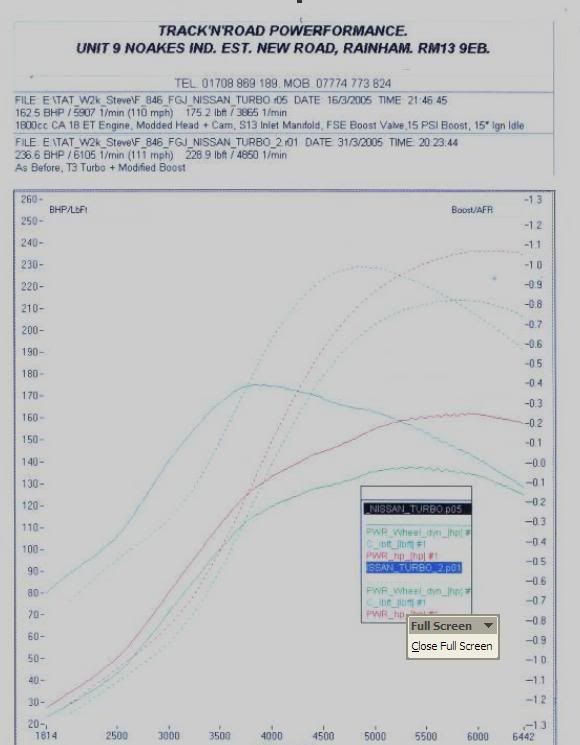
Took my CA18ET powered S12 on the rollers last week.

Got 215hp at the wheels, 236.6bhp at the fly...

I\'ll post a scan of the sheet in a day or so...

westside27375Apr 4, 2005, 9:24 am · #48

Nice numbers...

When you post the sheet, also include the specs on the engine.

30PSIApr 4, 2005, 9:40 am · #49
posted image
Shame that most of my posts have been lost, as the spec was detailed there.

Basically the spec is (if i can remember):

DET block
DET crank & flywheel
DET rods
JE forged pistons 7.8:1
268deg cam 1mm extra lift
Adjustable vernier pulley
Cosworth T3 turbo
Adapted DET front facing inlet manifold
Volvo intercooler & rad
S13 clutch
FSE adjustable fuel regulator
Bosch 040 fuel pump
17psi boost

I\'m going to convert to an aftermarket ecu and then run 20psi of boost.
MagnumApr 4, 2005, 4:46 pm · #50

What aftermarket ECU are you planning on using? Omex?